
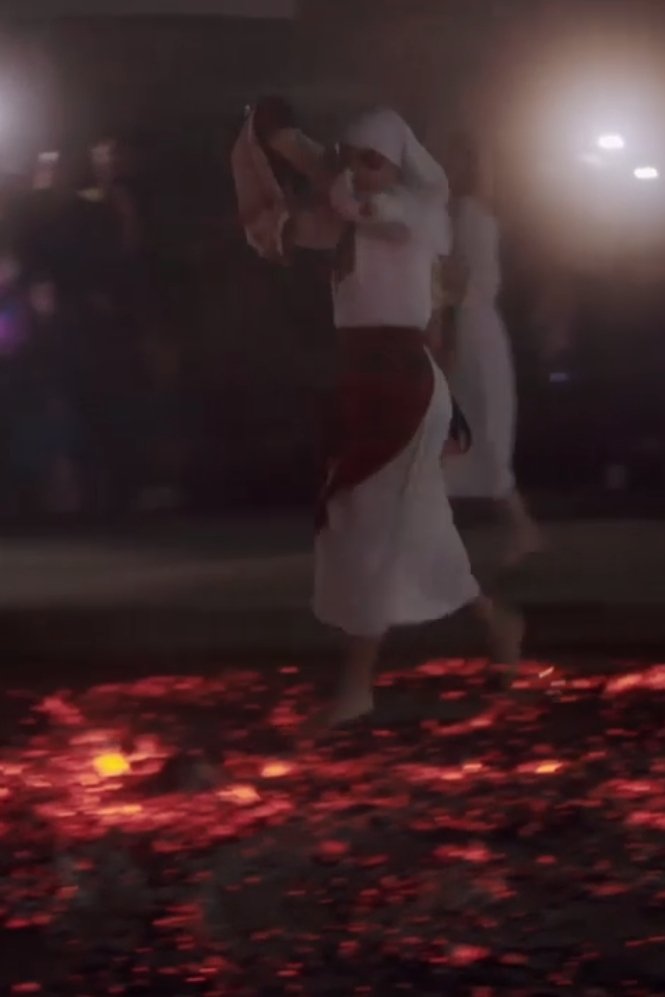
Bulgaria: Fire Dance Ritual
Release date: 2020-01-01
Votes: No data for this movie
Genres: Documentary
Every year in June, the small Bulgarian village of Balgari celebrates St Constantine with a special ritual. Initiated ‘nestinari’ go into a music-induced trance and dance on bonfires in a display of religious passion.
Reviews
No reviews for this movie.
Movie Recommendation
No recommendations for this movie.
Similar Movies
Bulgarian Lamentation...
 1968-01-01A documentary about lamentation songs of Bulgarian funeral rites.
Valašské tance
1949-01-01There is no descriptionHorňácká svatba
1945-01-01There is no descriptionOsipovův soubor v Pra...
1950-12-31Documentary about the concerts of the Russian Osipov ensemble of folk instruments in CzechoslovakiaThe Songpoet
 2021-04-24Eric Andersen is widely regarded as one of the most poetic songwriters that sprang from the Greenwich Village folk scene of the 1960s. His artful mélange of love, despair, hope and stirred memory has earned him a passionate international following and the respect and admiration of artists ranging from Joni Mitchell and Leonard Cohen to Lou Reed and Wyclef Jean. The Songpoet offers a look into the mind, soul and creative process of this multifaceted, complex and singularly driven artist whose career saw great expectations waylaid by misfortune.
Stvořeno z hlíny
1950-12-31Document about folk ceramic products from Moravian Slovácko and Wallachia.Fašánek
1949-01-01There is no descriptionPunky Night at Hinton...
 1977-10-27Children parade through the streets of Hinton St George in Somerset on the last Thursday of October. Children have hollowed out pumpkins or mangelwurzels, a type of animal fodder turnip to make lanterns following a tradition in this part of West Somerset that coincides with Halloween. Punky or Punkie Night is thought to date from the turn of the 20th century or perhaps medieval times chanting rhymes and following a Punkie King and Queen.
Wirklich alles?!
2002-11-30There is no descriptionComitiva Esperança
 1985-01-01There is no description
The Weavers: Wasn't T...
 1982-03-07Documentary about the blacklisted folk group The Weavers, and the events leading up to their triumphant return to Carnegie Hall.
Lidé pod sněhem
1948-01-01There is no descriptionLife from Life
 2021-09-11The film explores the hurdles facing organ transplant recipients in Bulgaria, once among Eastern Europe’s leaders in the medical procedure, but now ranking last on the continent for the number of transplants performed.
Previanti
1999-05-18There is no descriptionFolia no Morro
 2008-11-17An ethnographic documentary following the Folia de Reis party that is celebrated every year at Morro de Santa Marta on Rio de Janeiro.
Tramuntana
 2025-02-23In a remote area of northern Spain, the wind has a name: Tramuntana. Tramuntana takes what it wants—clothes, trees, boats, and the people of the landscape who live with the endless threat of being carried away by its force. This film is a lyrical portrait of this furious wind, woven from the stories passed down by local villagers.
Mi arma
 2019-11-10A young drag queen from Andalusia exposes the difficulties of adding aspects of her homeland culture to her artistic expression.
The Albion Band
 1979-12-31A rare 1979 BBC Arena documentary on the Albion Band, Ashley Hutchings and the development of English folk rock up to that time.
Slovenské ľudové tanc...
1952-01-01There is no descriptionShaping Bamboo
 1979-01-01For the 'Are'are people of the Solomon Islands, the most valued music is that of the four types of panpipe ensembles. With the exception of slit drums, all musical instruments are made of bamboo; therefore the general word for instruments and the music performed with them is "bamboo" ('au). This film shows the making of panpipes, from the cutting the bamboo in the forest to the making of the final bindings. The most important part of the work consists in shaping each tube to its necessary length. Most 'Are'are panpipe makers measure the length of old instruments before they shape new tubes. Master musician 'Irisipau, surprisingly, takes the measure using his body, and adjusts the final tuning by ear. For the first time we can see here how the instruments and their artificial equiheptatonic scale-seven equidistant degrees in an octave-are practically tuned.